
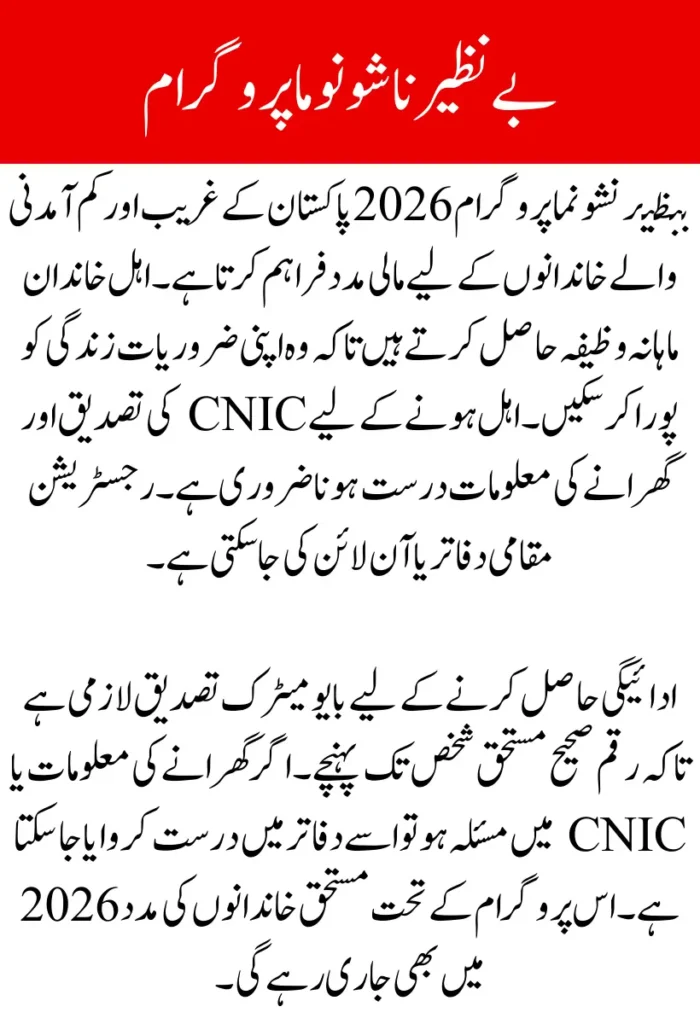
The Benazir Nashonuma Programme Payments 2026 provides financial support to low-income families across Pakistan. This government initiative ensures that vulnerable households receive monthly stipends to meet basic living expenses. In this guide, you will learn about eligibility criteria, the updated payment amounts for 2026, CNIC verification, registration steps, and how to receive funds safely through authorized channels.
 Also read
Eligibility Criteria for 2026
Households must meet specific conditions to qualify for the Benazir Nashonuma Programme Payments. Eligible families typically have low incomes and must be registered in national databases. Required documents include a valid CNIC, proof of residence, and basic household information. Priority is given to families in rural or marginalized areas. Beneficiaries are also required to update their data annually to ensure continued eligibility and prevent errors in disbursement.
Program Overview
| Topic | Key Information |
| Programme Name | Benazir Nashonuma Programme Payments 2026 |
| Target Beneficiaries | Low-income and vulnerable households |
| Eligibility Verification | CNIC-based verification and survey data |
| Monthly Payment | Updated stipend as per 2026 policy |
| Registration Process | CNIC verification at local offices or online portal |
| Payment Status Check | Online portal or SMS using CNIC |
| Fund Collection Method | Biometric verification via banks or authorized agents |
Payment Amount and Schedule
In 2026, monthly payments will be updated to better support beneficiaries’ living costs. The Benazir Nashonuma Programme Payments are distributed monthly, and each eligible household receives a consistent stipend to cover essential needs. Authorities release a payment calendar in advance, allowing beneficiaries to plan when and where to collect their funds.
 Also read
Registration and CNIC Verification
Registration begins by verifying the CNIC at local offices or online portals. During this process, applicants provide CNIC details, household information, and other required personal data. CNIC verification ensures payments reach the correct beneficiary and prevents delays. After verification, households are included in the official schedule for monthly disbursement.
Checking Payment Status
Beneficiaries can check the status of their payments online or via SMS. Entering the CNIC number on official portals confirms if payments have been processed and when the next stipend will be available. Keeping track of payment status is important for correcting any data errors and ensuring timely receipt of funds.
 Also read
Biometric Verification and Fund Collection
To ensure security and prevent fraud, all disbursements require biometric verification. Beneficiaries are asked to provide fingerprints or thumb impressions at banks or authorized agents. This process guarantees that funds are delivered to the correct individual. Carrying a valid CNIC is mandatory when collecting payments.
Challenges and Practical Tips
Some common challenges include outdated CNIC records, incorrect household information, or payment delays. Beneficiaries should update their data at local offices, verify survey information, and regularly check online portals. Following the payment calendar ensures funds are received on time without issues.
 Also read
Frequently Asked Questions
Who is eligible for the programme?
Families with valid CNICs and low income, registered under the government’s system.
How much will beneficiaries receive in 2026?
Payments are monthly and designed to cover basic household expenses.
Can payments be checked online?
Yes, by entering the CNIC on the official programme portal.
Conclusion
The Benazir Nashonuma Programme Payments 2026 play a critical role in supporting low-income households across Pakistan. By understanding eligibility, registration, CNIC verification, payment status checks, and biometric disbursement, beneficiaries can effectively receive their monthly stipends. Following official procedures ensures transparency, security, and timely delivery of funds.
 Also read