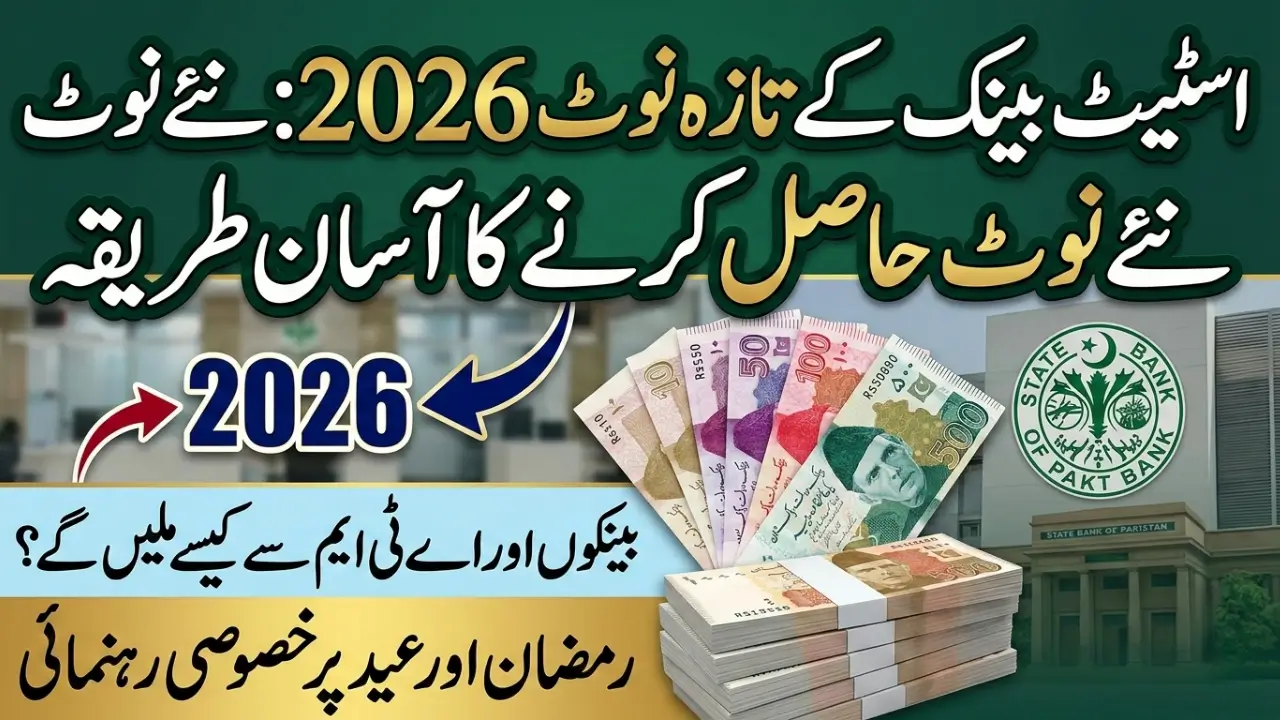
The demand for State Bank Fresh Currency Notes increases significantly in Pakistan during Ramadan and Eid. These notes are distributed to commercial banks by the State Bank of Pakistan, which then makes them available to the public. Citizens often prefer these notes for gifts, ceremonial payments, and special occasions because of their clean condition and crisp appearance.
In 2026, people can obtain fresh notes directly from bank branches, by using certain automated services, or by exchanging old notes at participating banks. This article explains the steps, eligibility requirements, and practical tips for obtaining Fresh Currency Notes efficiently.
 Also read
How Fresh Notes Are Distributed
The State Bank of Pakistan supplies State Bank Fresh Currency Notes to commercial banks nationwide. The banks then act as the primary distribution centers for citizens. During Ramadan and Eid, additional allocations are provided to meet the higher demand.
Key aspects of distribution:
- Account holders often receive priority, though walk-in customers are also served.
- Notes are delivered in sealed bundles to preserve quality.
- Bank staff follow verification procedures to ensure fair access.
Overview
| Category | Details |
| Issuing Authority | State Bank of Pakistan |
| Distribution Points | Commercial bank branches |
| Required Identification | CNIC/National ID |
| Peak Period | Ramadan and Eid |
| Available Denominations | Rs10, Rs20, Rs50, Rs100, Rs500 |
| Alternative Access | ATMs and bank booking services |
Obtaining Fresh Notes from Your Bank
The most straightforward way to get State Bank Fresh Currency Notes is through your local bank branch. The procedure is as follows:
- Visit the branch during regular working hours.
- Present a valid CNIC for identification.
- Request the denominations you need from the teller or service desk.
Smaller denominations, such as Rs10, Rs20, Rs50, and Rs100, are usually in higher demand for gift purposes, while Rs500 notes are preferred for larger transfers.
 Also read
Automated Services for Fresh Notes
Certain banks provide automated options to simplify access to Fresh Currency Notes:
- Selected ATMs are stocked with new notes during festive periods.
- Some banks offer online or SMS-based booking for priority collection.
- A valid CNIC and bank account may be required to use these services.
These methods can save time and ensure access before peak demand.
Common Denominations and Packaging
Banks usually distribute the following denominations of Fresh Currency Notes:
- Rs10, Rs20, Rs50, Rs100 for small gifts
- Rs500 for medium payments
- Notes are delivered in sealed bundles or packets to maintain their condition
Smaller denominations are preferred for personal gifting and social transactions, while medium denominations are used for business or ceremonial purposes.
 Also read
Planning Ahead for Fresh Notes
High demand in the last two weeks of Ramadan makes early planning important. Tips to secure Fresh Currency Notes include:
- Visit your bank branch well in advance of Eid.
- Use your main bank branch where you hold an account for priority service.
- Avoid purchasing from unofficial sources, which may carry counterfeit notes.
Proper planning ensures that fresh notes are obtained in time for gifting and payments.
Frequently Asked Questions
Can I get fresh notes without a bank account?
Yes, some branches exchange old notes for new ones even for non-account holders, though account holders usually receive priority.
Are fresh notes available at ATMs?
Some ATMs are stocked with new notes during festival periods. Availability depends on the bank and region.
Will the new notes introduced in 2026 replace old notes immediately?
No. Current notes remain valid alongside new designs until the central bank completes a gradual phase-out.
 Also read
Conclusion
Obtaining State Bank Fresh Currency Notes in Pakistan in 2026 is straightforward when proper planning is followed. By visiting bank branches early, using automated services, and focusing on the denominations needed for gifting, citizens can ensure timely access to fresh notes. With redesigned notes expected later in 2026, Pakistan’s currency system continues to evolve with enhanced security and modern designs.
 Also read